
A failed floor rarely costs much in paint. It costs in downtime. An aisle closes for recoating, or a food plant gets flagged at audit because its floor can no longer be cleaned properly.
Many of those failures start with the wrong coating system. So which one does your floor need, epoxy or polyurethane?
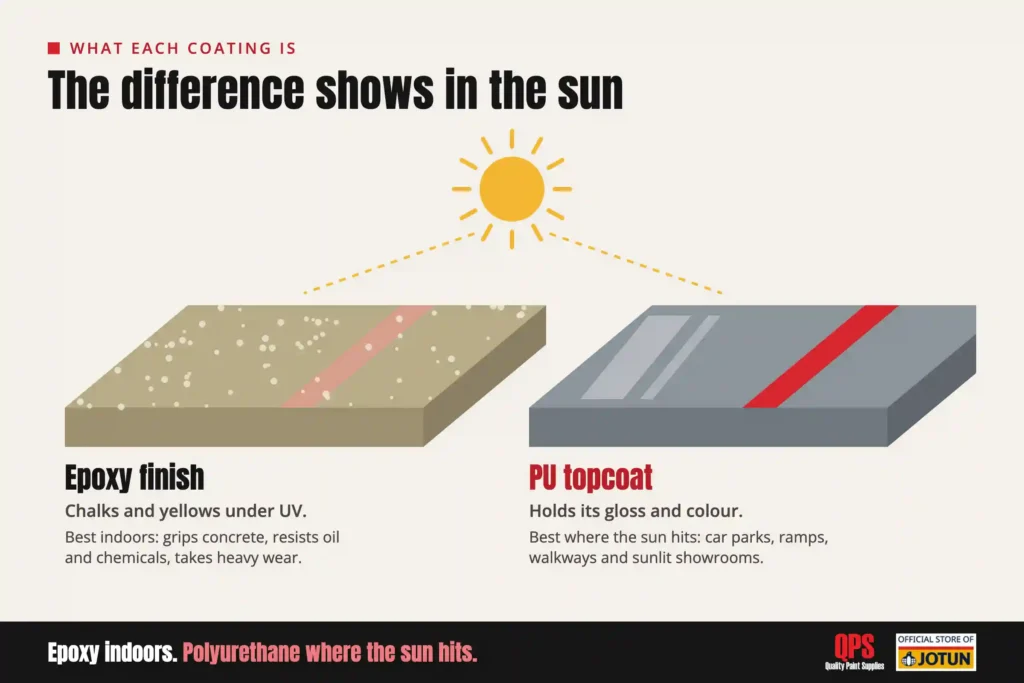
Epoxy floor coatings are harder and more rigid, and they bond firmly to concrete. Polyurethane coatings are more flexible and far more UV resistant, so they keep their colour in the sun.
That matches what we see on site, and Jotun’s data backs it up. It rates Jotafloor PU Topcoat as non-yellowing for sunlit car parks and ramps, while its Jotafloor epoxies are built for heavy wear and chemical attack.
Epoxy vs polyurethane at a glance
| Property | Epoxy | Polyurethane |
|---|---|---|
| Main job in a system | Primer, build coat and interior finish | Topcoat over an epoxy build |
| Adhesion to concrete | Bonds and seals the substrate | Needs an approved primer beneath it |
| Abrasion and impact | Very high, especially glass-flake reinforced grades | Good |
| Chemical resistance | Very high | Good |
| UV and sunlight | Chalks and yellows in direct sun | Non-yellowing; holds gloss and colour outdoors |
| Flexibility | Hard and rigid | More flexible; copes better with temperature swings |
| Best suited to | Warehouses, workshops, plant rooms, factories | Car parks, ramps, driveways, walkways, sunlit areas |
| Jotun products at QPS | Jotafloor Sealer, SF PR 150, Topcoat E, Glass Flake | Jotafloor PU Topcoat |
What each coating is
Epoxy floor coatings
Epoxy comes in two parts, a resin and a hardener. Once mixed, they react and form a dense, cross-linked film. That’s where epoxy gets its grip on concrete and its resistance to oil and most industrial chemicals.
Solvent-free epoxies such as Jotafloor Topcoat E build a thick film in fewer coats and give off little odour.
That matters in food plants and anywhere people keep working during the job.
For heavy wear, glass-flake grades like Jotafloor Glass Flake add tiny flat glass particles to the film, which toughens it against abrasion and impact.
Epoxy has one real weakness: sunlight. It chalks and yellows under UV, so keep it indoors or cover it with a UV-stable topcoat.
Polyurethane floor coatings
Polyurethane is also a two-part coating, but it cures to a more flexible film. Aliphatic grades such as Jotafloor PU Topcoat don’t yellow, and they hold their gloss and colour in direct sun.
We recommend it for car parks, ramps, walkways and traffic decks.
It doesn’t grip bare concrete as well as epoxy, though, and it goes on thinner. So it’s applied over a primer, and usually over an epoxy build coat as well.
Why most floors use both
A high-performance floor is a system, not a single coat. Each layer does one job, and the product is chosen to suit it.
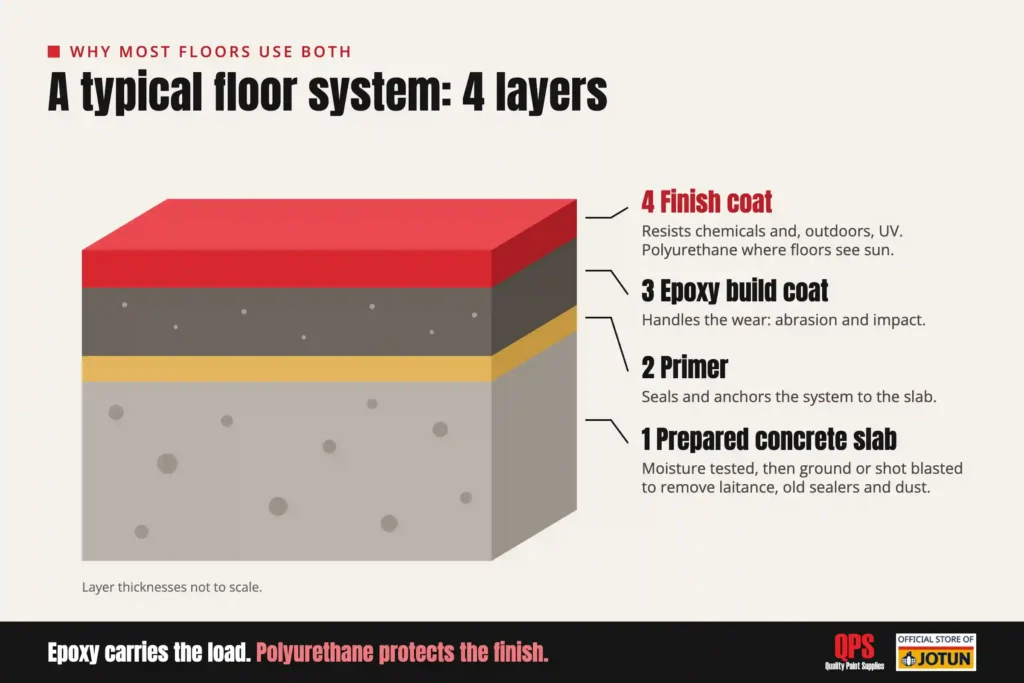
The primer seals the slab and anchors the system. The build coat takes the wear. The finish coat protects against chemicals and, outdoors, UV.
Choosing a system for your environment
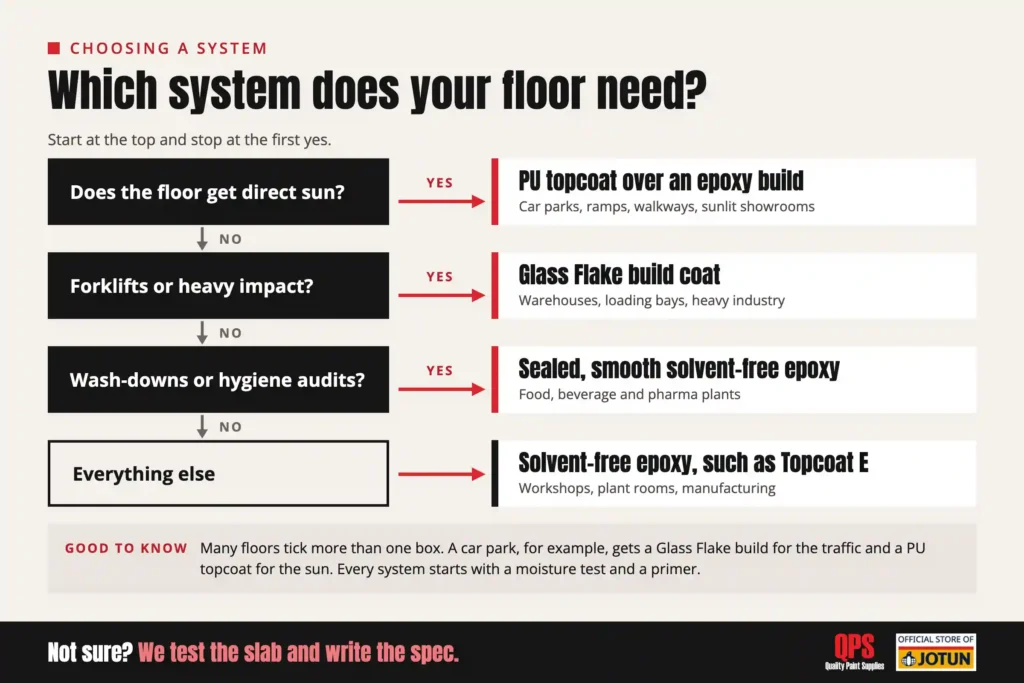
Traffic, spills, sunlight and cleaning decide the system.
Here’s how that plays out in the settings we specify for most.
Warehousing and logistics
Forklifts grind through thin coatings fast. The damage starts where they turn, in aisles and at loading bays, so these floors need a thick, abrasion-resistant build.
Typical system: Jotafloor SF PR 150 primer, then Jotafloor Glass Flake as the wearing layer. It’s made for heavy-duty industrial floors that take constant abrasion and impact.
Manufacturing and heavy industry
Here the threat is as much chemical as mechanical. Hydraulic oil, cutting fluids and cleaning agents all attack a weak coating, and dropped tools chip it.
Typical system: a primer, then Jotafloor Topcoat E, a solvent-free epoxy that stands up to chemicals and knocks. It’s a good fit for plant rooms, workshops and battery rooms. Where impact is severe, a Glass Flake build goes underneath.
Food, beverage and pharmaceuticals
According to a PDF reference on health.gov.za in South Africa, Regulation R638 of 2018 requires floors in food premises to be smooth, non-absorbent, cleanable, water-resistant and free of open joints or seams. The floor also has to survive daily wash-downs with strong cleaning chemicals.
Typical system: a sealed, solvent-free epoxy system with a smooth or lightly textured finish. Jotafloor Sealer (a two-part epoxy sealer) is designed for labs and food and beverage plants that need a sealed, dust-free surface. Go easy on slip texture here, because a rougher floor is harder to clean.
Car parks, ramps and outdoor areas
In an open car park or on a sunlit ramp, an epoxy-only floor will chalk and lose its colour.
Typical system: an epoxy primer and Glass Flake build to take the wear, finished with Jotafloor PU Topcoat to hold the colour. On ramps and walkways, non-slip aggregate goes into the system too.
Commercial spaces and showrooms
Owners want a high-gloss, easy-clean floor in exact brand colours, without giving up durability.
Typical system: an epoxy build with a gloss finish coat, tinted at our premises to the required colour. Where the space gets direct sun through glazing, a polyurethane topcoat keeps the colour stable.
| Environment | Main risk | Build coat | Finish |
|---|---|---|---|
| Warehousing and logistics | Abrasion from forklifts | Jotafloor Glass Flake | Glass Flake or Topcoat E |
| Manufacturing | Chemicals and impact | Glass Flake where impact is heavy | Jotafloor Topcoat E |
| Food, beverage, pharma | Hygiene and wash-downs | Solvent-free epoxy | Smooth epoxy finish |
| Car parks and ramps | UV and vehicle wear | Jotafloor Glass Flake | Jotafloor PU Topcoat |
| Commercial and showrooms | Appearance and cleaning | Epoxy build | Gloss epoxy or PU in brand colours |
Why floor coatings fail
When a floor fails early, the product is rarely to blame. Something went wrong before or during application, and it’s usually one of these.
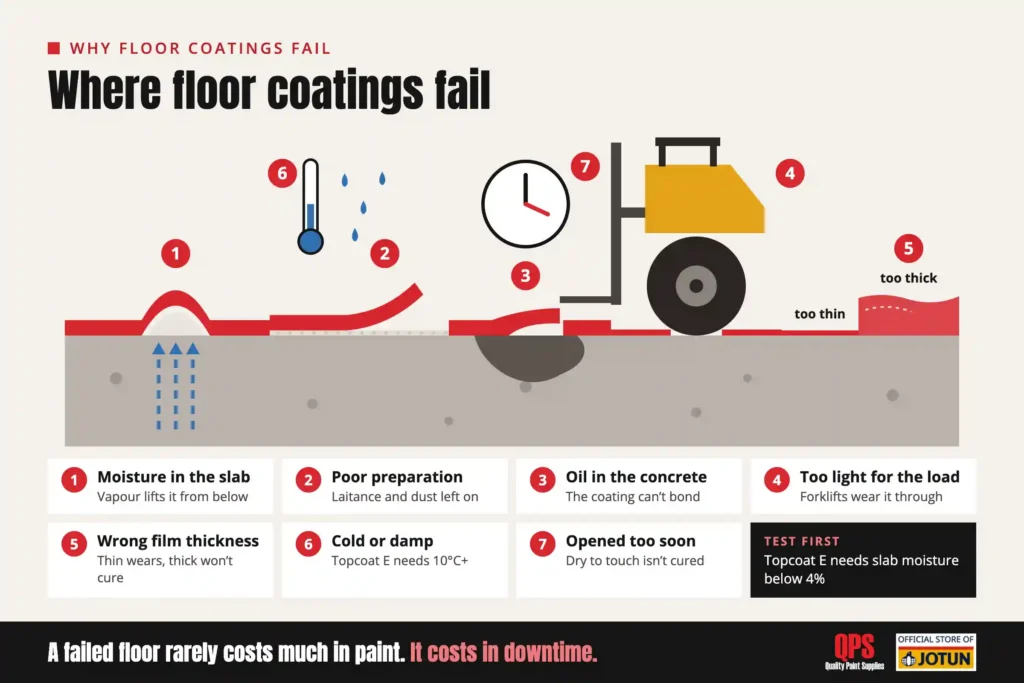
- Moisture in the concrete. Water vapour rising through the slab pushes the coating off from below, and it blisters and lifts. ASTM F2170, the standard test for moisture in concrete slabs, lists debonding among the failures that excess moisture causes. The Jotafloor Topcoat E data sheet, for example, requires the concrete moisture content to be below 4% by weight. That’s why we test substrate moisture before recommending any system.
- Poor surface preparation. A coating needs something to grip. The weak top skin of the concrete (called laitance), old sealers and dust all have to come off, usually by grinding or shot blasting.
- Contamination. Years of oil soaked into a workshop slab will stop any coating from bonding. It has to come out first.
- The wrong system for the load. A thin, light-duty coating in a forklift aisle will wear through, however well it was applied.
- Low film thickness. Every product has a specified dry film thickness. Applied too thin, the coating wears through early. Applied too thick in one pass, it may not cure properly.
- Applying outside the right conditions. Cold and damp conditions slow curing and weaken the bond. Topcoat E, for instance, needs a substrate temperature of at least 10°C.
- Opening the floor too soon. Dry to the touch isn’t the same as cured. Keep traffic and chemicals off until the full cure time on the data sheet has passed.
Slip resistance and safety colours
A smooth gloss floor turns dangerous when it’s wet or oily. And under section 8 of the Occupational Health and Safety Act 85 of 1993, keeping the workplace safe, so far as is reasonably practicable, is the employer’s legal duty.
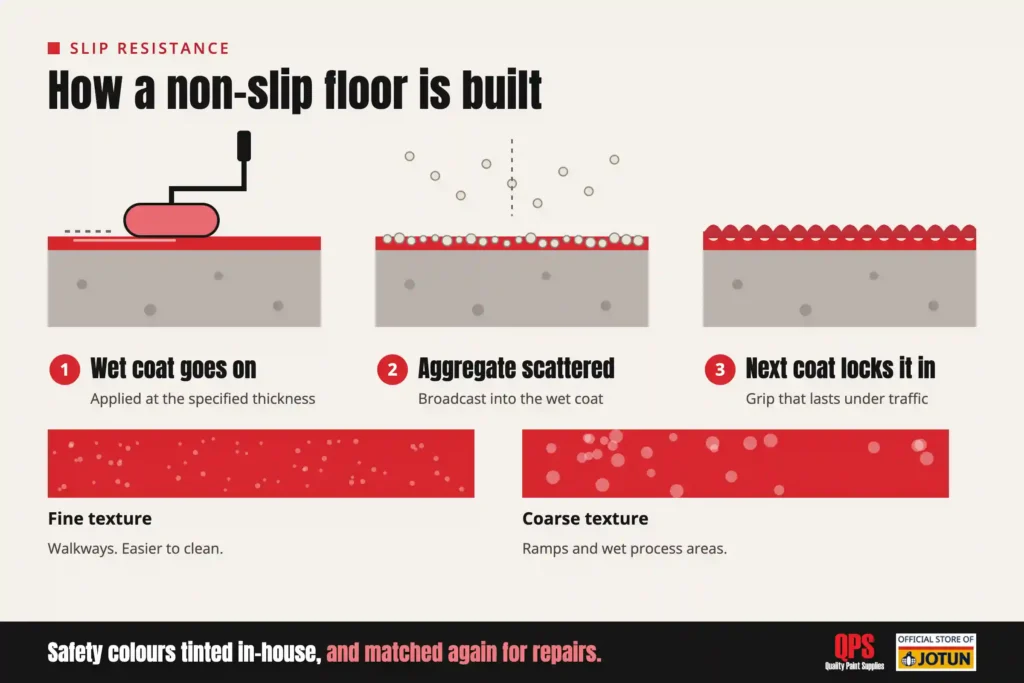
Where grip matters, the applicator scatters a non-slip aggregate into the wet coat and the next coat locks it in. Finer textures suit walkways and clean more easily. Coarser ones suit ramps and wet process areas.
Clear marking makes walkways, forklift routes, hazard zones and loading bays easier to manage. QPS tints Jotafloor finish coats at our Thornton premises to your safety or brand colours, using Jotun’s Multicolour Industry system.
When the floor is extended or repaired, we match the original colour consistently.
How a floor gets specified with QPS
We stay involved from the first site visit to final sign-off, working with Jotun’s national technical network.
- Site inspection. We inspect the floor on site and test substrate moisture, which determines which coatings can be applied.
- Specification. We prepare a Jotspec specification covering surface preparation, each coat, film thicknesses and curing times.
- Colour matching. Finish coats are tinted on our premises to your safety or corporate colours.
- Reference area. We check a sample area first, so everyone agrees on the standard before the full floor goes down.
- Progress inspections. We take dry film thickness (DFT) readings and report on surface preparation, primer and finish coats.
- Sign-off. We inspect the finished floor against the specification and help sort out anything that isn’t right.
Most floors we get called out to didn’t fail because of the paint. They failed because nobody asked the right questions before the first coat went down. We’d rather spend an hour testing a slab than a week explaining why a floor lifted. That’s what finding solutions instead of making excuses looks like on site.
Marco Speck, founder, Quality Paint Supplies
Frequently asked questions
How long does an epoxy floor last?
Longer than most people expect, if the slab was prepared properly and the system suits the traffic. Skimp on either and even a good product wears through early. When areas do wear (forklift turning points tend to go first), you can usually recoat them without stripping the whole floor.
Can epoxy be used outdoors?
Yes, but not as the top layer. Sunlight chalks and yellows epoxy, so outdoors it goes underneath as the build coat, with a UV-stable polyurethane such as Jotafloor PU Topcoat on top.
What are the downsides of epoxy flooring?
Sunlight is the big one, which is why outdoor floors need a polyurethane topcoat. Epoxy is also rigid, so it can crack where the slab moves, and it won’t stay stuck to damp concrete. Test the slab first and pick the right system, and none of these should catch you out.
Can you coat over an existing floor coating?
Often, yes. If the old coating is still well bonded, we test its adhesion, it gets roughened up and the new system goes on top. If it’s already peeling, it has to come off first.
How soon can the floor take foot and forklift traffic?
It depends on the product and the weather. Every data sheet gives separate times for foot traffic, light traffic and full cure (the one that counts for forklifts), and cold weather stretches all of them. Plan your shutdown around full cure. A floor that feels dry can still be soft underneath.
What is the difference between a DIY epoxy kit and an industrial system?
A DIY kit is made for a home garage, your typical car or two household (and the odd oil drip). An industrial system is specified for a known load and applied at a set thickness over properly prepared concrete, with checks along the way. Put both under forklift traffic and the difference shows quickly.
Not sure which system your floor needs?
Book a site inspection. We’ll test your slab, look at how the floor is used and write a specification to match. Our technical team aims to reply to every enquiry within 24 hours.
Call 021 510 1454 or contact our technical team. You can also see the full range on our Floor Coatings page.
Quality Paint Supplies, 28 Thor Circle, Viking Park, Thornton, Cape Town.
About Quality Paint Supplies
Marco Speck founded QPS in 2001. Today it is a National Coatings Specialist Distributor for Jotun, supplying marine, protective and floor coatings to the mining, marine and infrastructure industries from Thornton, Cape Town. Jotun trains the whole team on its Multicolour Industry tinting system, and the business runs on long-term customer relationships.